
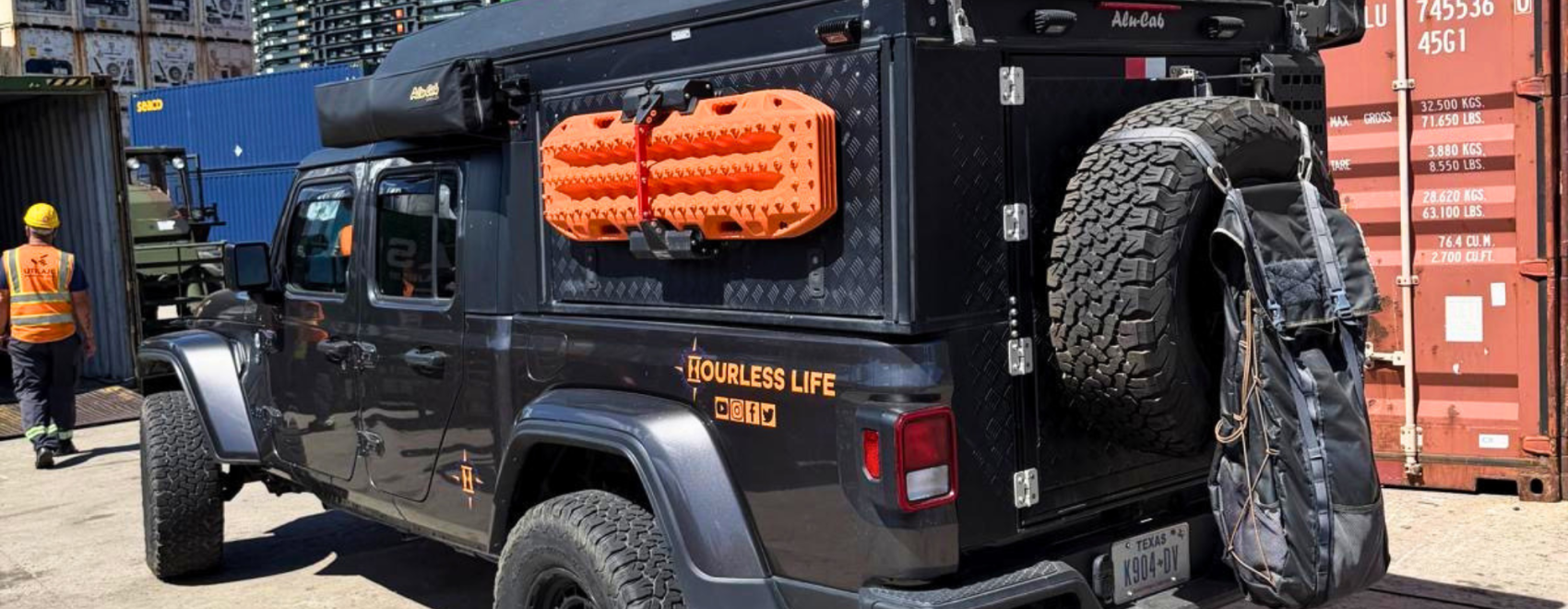
Most of the time, overlanding vehicle owners ship their vehicles in person. They’re available to sign all the paperwork, interact with the shipping agent, drive their vehicle into port, and see it loaded into the shipping container or parked for roll-on-roll-off shipping.
But on rare occasions, circumstances don’t allow the vehicle owner/overlander to be there in person. Maybe there is a family emergency or a whirlwind of logistics requiring the owner to be elsewhere. It happened to us.
This is the story of what it took to ship our vehicle from one international port to another when we weren’t there in person. Being there in person is hard. But for a while, doing it remotely seemed nearly impossible. I wasn’t able to find someone else this had happened to, to pick their brain and have them hold my hand. So I’m writing this in hopes it will be useful to others.
Before we left our vehicle behind
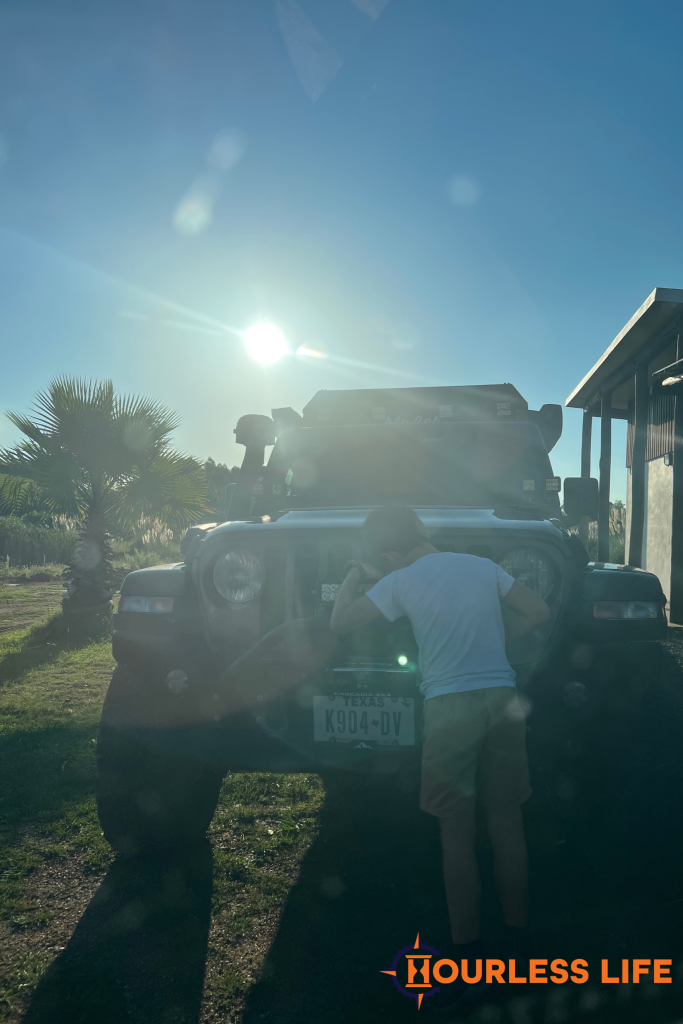
After more than three years of overlanding through Latin America, we wanted our Jeep home to stay in storage for a few months in Uruguay (a country with a generously long temporary import permit length). But then we needed the Jeep to be taken out of storage and shipped from Uruguay to South Africa, without us being there in person.
Long before we left Uruguay, we asked every question we could think of to make sure the plan was possible.
- We found a trustworthy place to store our vehicle. They agreed to wash the Jeep before shipping (shipping companies don’t like to ship dirty vehicles). They agreed to disconnect our batteries for storage and reconnect them for going to the port. And we made sure to have less than 1/4 tank of fuel, which was a condition for shipping.
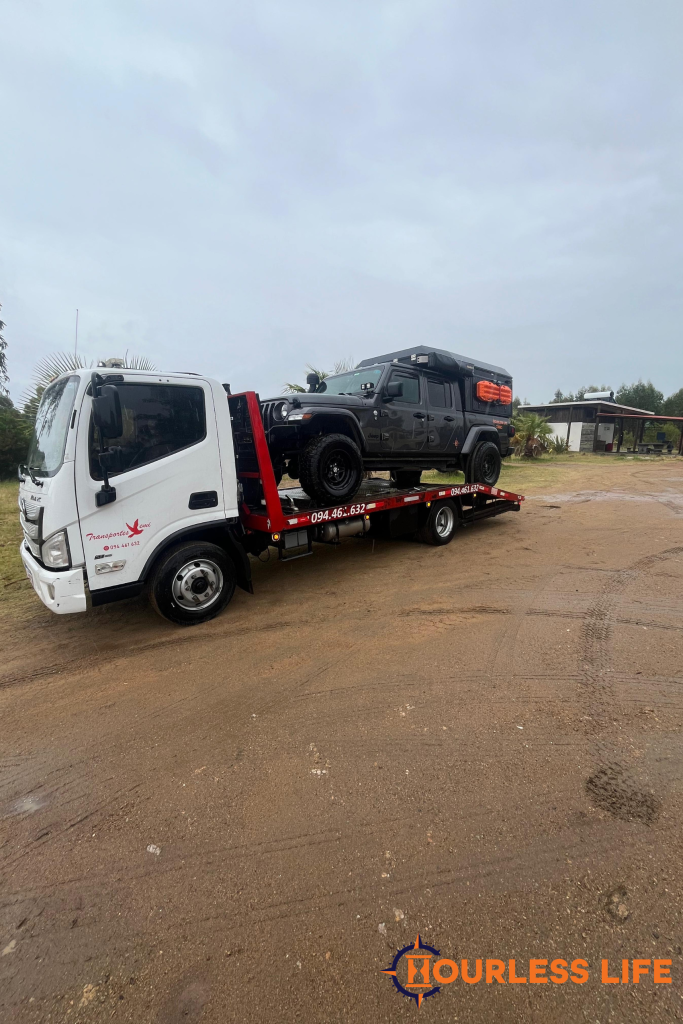
- Overland Embassy, our liason, assured us that a tow truck could take the vehicle to port, and they provided a quote.
- The estimated shipping time from Montevideo to Cape Town was given as 45 days. We planned our arrival in Cape Town around this estimate and bought our plane tickets to get to Cape Town and meet the Jeep at port.
Surprise paperwork
With all the information we gathered, the plan seemed solid. We left the Jeep in storage in Montevideo and flew to Mexico for a break from the road.
Six months passed. About a month and a half before we needed to ship, we contacted Overland Embassy to confirm details and get the ball rolling. That’s when we received new information: we needed a Power of Attorney to drop the Jeep off at port and possibly interact with customs. This wasn’t a total surprise, but we’d incorrectly assumed Overland Embassy’s local team would do this.
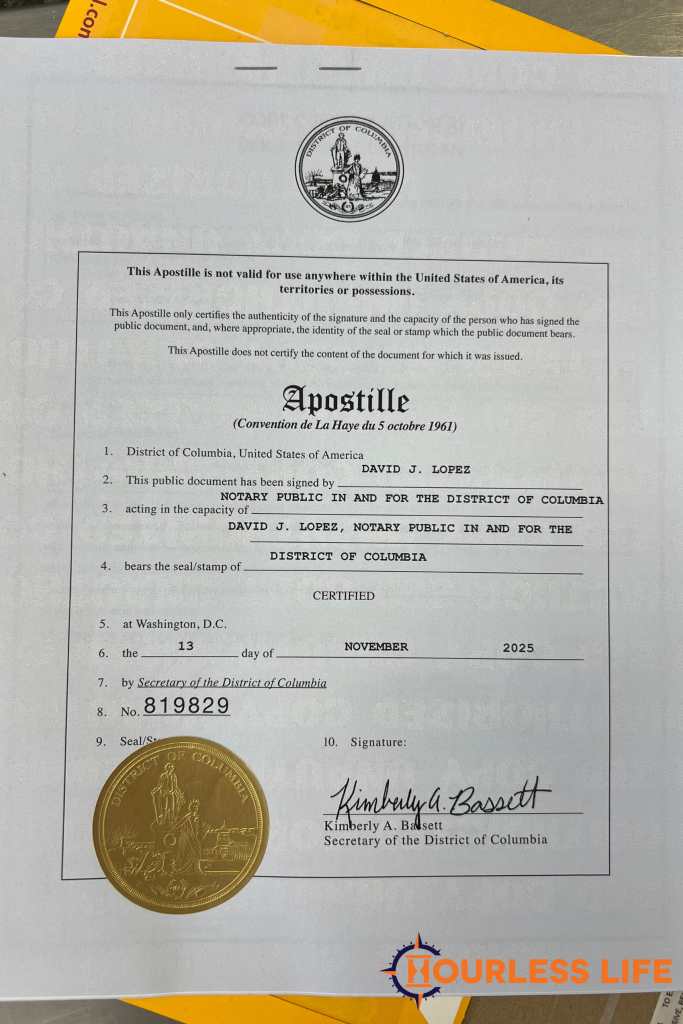
The surprise was that the Power of Attorney document had to be notarized and apostilled, launching a bureaucratic avalanche we’d have to maneuver through across continents and different languages.
Considering I didn’t know what an apostille was, this seemed like big trouble.
The easy/easier way
If we had known about the requirements for the Power of Attorney document, then we would’ve taken care of it when we were in Montevideo in March 2025. We could’ve found a person to be Power of Attorney, then notarized and apostilled the document in person. In Uruguay. Then everything would be ready when it was time to ship.
The very hard way
Instead, a ton of steps were added. Because we weren’t in Uruguay anymore, the rudimentary Power of Attorney document (template sent to us by Overland Embassy’s team in Montevideo) had to be notarized and apostilled in the United States first.
Not only that, but it had to be professionally translated and certified. All these things cost money. But more relevant for us, they took time. Time we didn’t have. When we found out about all this, our ship date was only 40 days away.
After the document was translated, notarized, and apostilled in the United States, we had to mail the physical document to Uruguay. Then Overland Embassy’s local team at Wave Logistics would have it notarized and apostilled there.
Navigating countless challenges: apostille and more
I was very distracted by how to pronounce the word “apostille.” Beyond that, my questions were so many they were in a jumble. The main ones:
- Who will be our Power of Attorney? (We asked our storage team, but they said they don’t offer this service “anymore.”)
- What is an apostille and how do you get one? Do we have to get it done at the state or federal level? What are the steps, how much does it cost, and how long does it take?
From my research, I determined the document could be apostilled at the state level. But since we wouldn’t be back in our home state (Texas) in time to ship the Jeep, this wasn’t an option. There are many specific steps required when going through your state, but they boil down to translation, notarization, and apostillation. On Nov. 5, 2025, the Texas Secretary of State said they were processing requests from Sept. 9. So we’d be looking at a 1- to 2-month wait time.
It is a similar process at the federal level. Many steps, long process. Not including the certified translation and the time it takes to mail the document back and forth, I read we might complete the apostillation process in three weeks if we interacted with the federal agency directly.
But at the time, the federal government was shut down in the United States, causing delays and backlogs across many agencies. Because of this, I was doubtful the three-week timeline was correct. And rush processing was not available because it could only be requested for life and death circumstances.
I continued researching. I found a company in Washington D.C. called One Source Process. They seemed legitimate with good reviews, though not the least expensive option. For a fee, they provide door-to-door service through the whole process. They can professionally translate, notarize, and apostille documents. Best of all, they offer a rush service of 1-3 days (again, for an extra fee). When we added everything up in our quote, the total came out to $335. Steep, but necessary if we were going to move our home from one continent to another within our timeframe.
Why apostille?
So what is an apostille anyway, and why did we need one? Under the 1961 Hague Convention, Uruguay is one of many countries that use apostilles to “authenticate” documents. Their usefulness is doubtful, but they look impressive (that gold seal!). Welcome to bureaucracy at its finest.
Once we had a solution for processing the Power of Attorney document in the U.S. through One Source Process, there was one big barrier left: we needed a person to agree to be POA before we could start on the document. Thankfully, Overland Embassy came through and provided a lead within two days. We messaged Kiernen on Whatsapp and worked out the preliminary details.
Overland Embassy told us Kiernen should prepare for “the full day experience” on shipping day, which is to say it could be a long day. They assured us their local partner, Rachida at Wave Logistics, would be there to walk Kiernen through everything on our behalf. Overland Embassy suggested we compensate Kiernen between $200-350 for his help. We also had a Plan B, a law firm in Montevideo that provided POA services, normally in the context of real estate (our Jeep is like our real estate).
Once the POA document was filled out, I sent it to Kiernen to confirm the details, then to Rachida to make sure everything looked right. Then we paid $300 to One Source for 1-3 day processing, the D.C. Secretary of State fee, a custodian form (because we didn’t notarize the document ourselves; they did it on their end), and return shipping.
Most of the fee was to One Source, $225 of it, which is steep considering they just had to walk it into the right office(s). If we were in our home state of Texas with enough time, we may have done this ourselves. But under the circumstances, using One Source seemed like the absolute best option–maybe our only one.
To One Source’s credit, the document was ready one business day later. They stuck it in a FedEx package, and we got it back only two business days after we emailed it to them. This was a lightning-fast turnaround.
On to Uruguay
Up until this point, the bureaucratic challenges felt so insurmountable I wasn’t sure whether everything would fall into place. There was a scenario where Eric would have to fly to Montevideo by himself to make the shipping happen.
But once I had the apostilled Power of Attorney document back from One Source, it felt like the hard stuff was mostly behind us.
We were in Florida at the time. I took the physical document to a DHL office and sent it off to Montevideo for $170, to arrive the same week.
Rachida at Wave Logistics took care of the rest of the document processing, which cost another $470. All other paperwork was taken care of by Kiernen, now our designated Power of Attorney.
Power of Attorney angel
It’s easy to focus on things that go wrong and spell out all the negative details. What we don’t always stop and notice is what goes right. This guy Kiernen was a total stranger to us. Though he was part of our wider community (he and his wife overlanded from the states to South America, where they decided to settle in Montevideo), we were unknown to him and he didn’t owe us a thing.
Unsurprisingly to anyone who has ever shipped a vehicle, Kiernen had to do more than just show up on the day of shipping like we were first told. There were extra meetings for paperwork. There were long waits and reschedulings. But he never complained. He was the perfect combination for the situation: low-key and seemingly impossible to rattle, but with the attention to detail that was needed to take care of our home.
We will never forget the role Kiernen played in helping us continue our drive around the world.
Shipping day in Uruguay
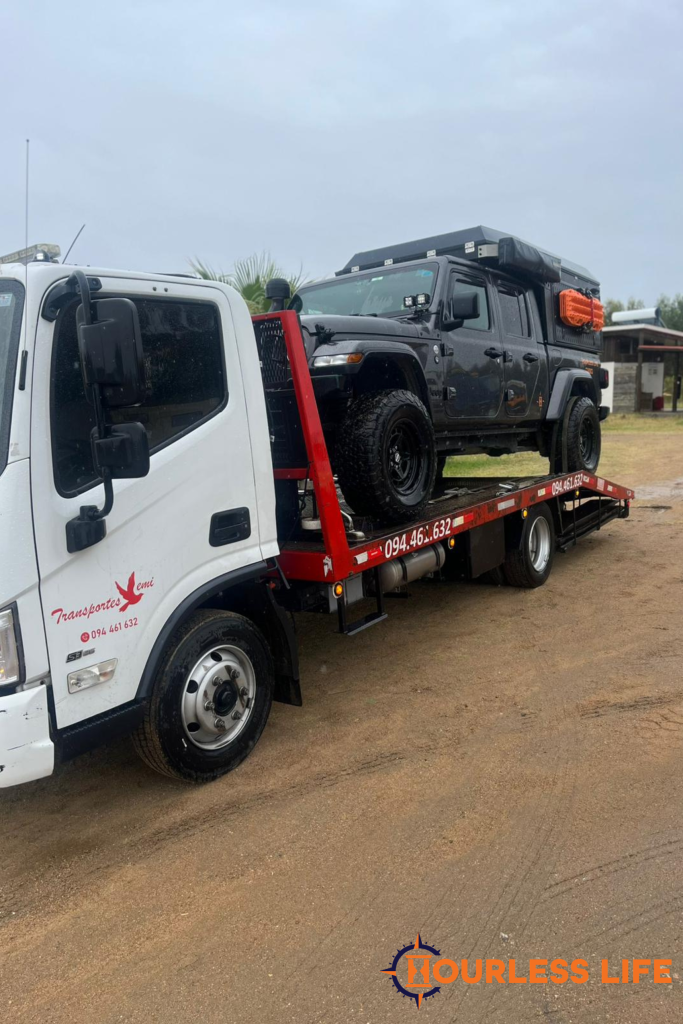
There were still hiccups at the last minute. Our storage company in Montevideo, which I am purposely not naming, tried to reneg on washing the Jeep (even though they’d agreed to it at drop-off). They also made a strong threat about not releasing our Jeep to the tow truck if our payment hadn’t gone through, even though we were not remotely late with payment.
But, in the end, they did wash the Jeep and they did let the tow truck pick it up!
Then there was a problem with the Jeep not starting on load day. We still don’t know what happened. Communication was a little chaotic, but we all worked together to make it happen.
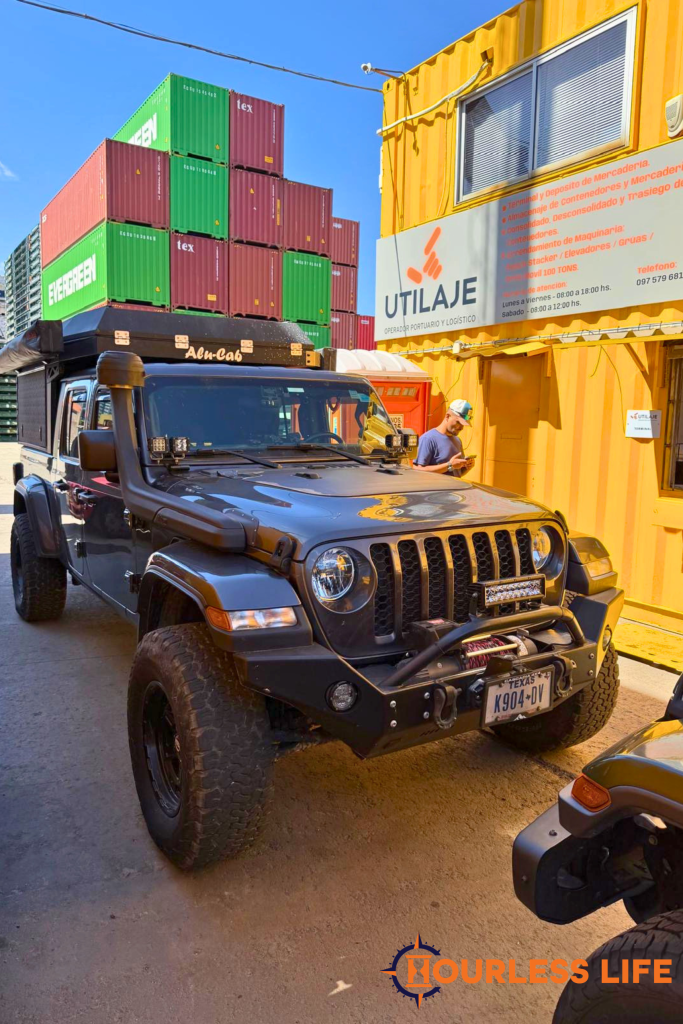
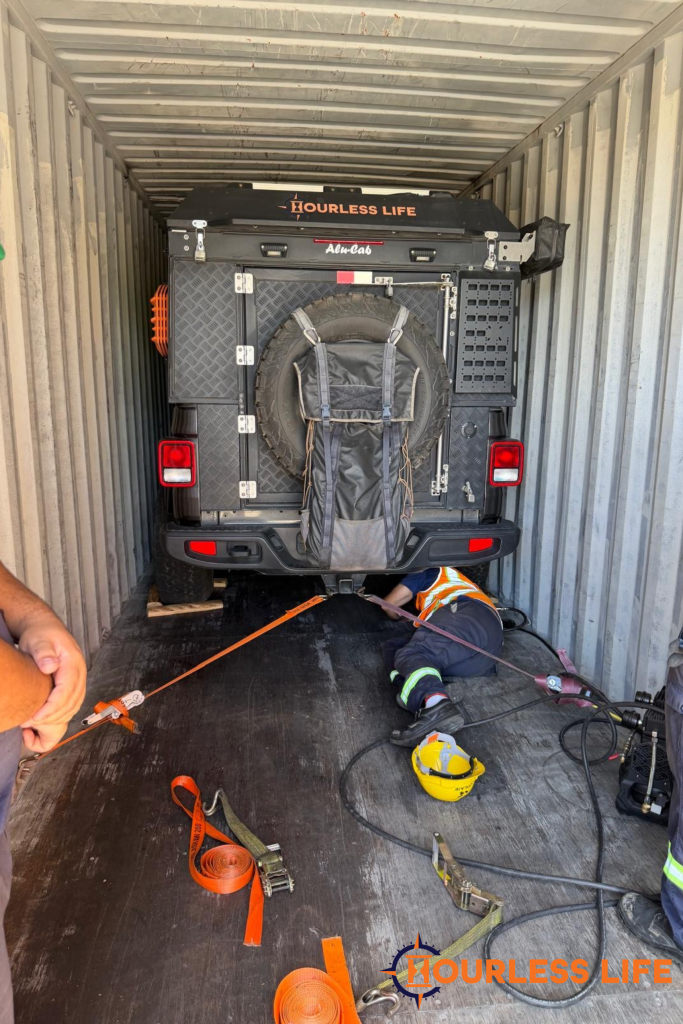
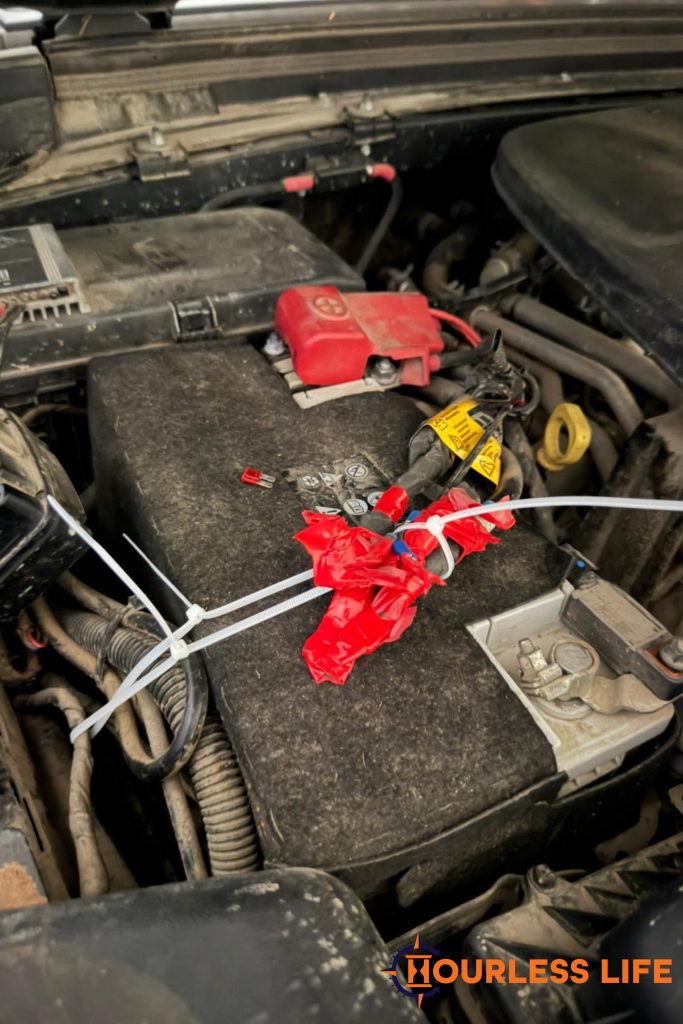
We sent specific instructions on how to disconnect the Jeep batteries for the 45-day Atlantic crossing (there are two batteries in the Jeep Gladiator: main and auxiliary). We also sent instructions on how to use wooden blocks and straps to secure the Jeep properly. We paid $240 for extra straps, to ensure the Jeep did not move on the high seas.
We submitted our payment to Wave Logistics via wire transfer. Now we would wait for Dauntless to arrive in Africa!
Unloading in Africa
Dauntless arrived in Africa in the new year, January 2026. Getting him out of port in Cape Town was as much of an adventure as getting him off the continent of South America. But that’s another story.
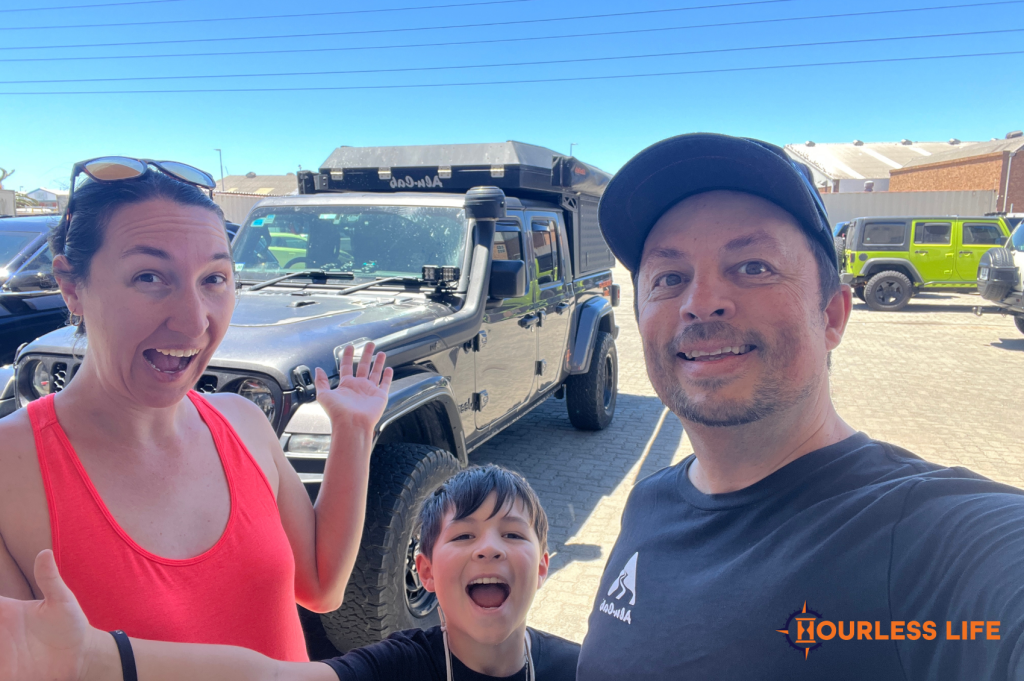
For the purposes of this article, we’ve now shared the story of what it takes to ship a vehicle when you aren’t there in person. To recap, here are the main lessons we’d want you to take away.
Lessons learned: how to ship your vehicle when you aren’t there in person
1/ Ask questions that seem unnecessary
I am extremely detail-oriented, and I promise I asked a lot of questions before we left Dauntless in Uruguay. But I didn’t ask enough questions. If I had pressed into the Power of Attorney question more, then we could’ve done the paperwork when we were in Montevideo and saved hundreds of dollars (and headaches) in the long run.
Whatever your concern, don’t assume the other party will volunteer the necessary information. Different cultures communicate differently. So ask more questions than you think you should ask.
2/ Check port fees on the receiving side
I can’t believe we made this error. I’ve heard of this problem biting overlanders and I did not think it would happen to us. For whatever reason, I thought our shipping quote from Overland Embassy included everything: the Montevideo side and the Cape Town side. This was not the case.
Before shipping, confirm the fees not just on the sending side, but on the receiving side.
3/ Check your container size
This was something that never even occurred to me to ask about. For some reason, Dauntless was shipped in a 40-foot shipping container. Because we did not have a container buddy, a 20-foot container would have been sufficient.
Instead of paying for a 20-foot container, we ended up having to pay for a 40-foot.
So I recommend you double-check you’re shipping in a 20-foot container if you don’t have a container buddy.
4/ If you can possibly help it, be there in person to ship your vehicle
Our biggest take-away lesson: if you can possibly help it, then be there in person to ship your own vehicle. Moving forward, we will always avoid shipping remotely if we can. The process was complicated and expensive, and being there in person allows for more efficient trouble-shooting as problems arise (which they always do).
All told, I estimate we spent $1,200-1,600 extra because we were not in Uruguay in person. At the time, we were visiting friends and family in the United States. To be in Uruguay in person, we’d have had to purchase at least one transcontinental flight, pay for lodging in Montevideo, and interrupt our U.S. visit. So we balanced the extra expenses of the shipment against what it would’ve cost to go back to Uruguay.
Any questions?
Obviously a lot of this is anecdotal. We are sharing our personal experience from one transoceanic shipment. But I do believe the takeaways are fairly universal.
What about you? Do you have any questions, or your own experience to share? I’d love to hear about it.
We have at least two big shipments to go, including our next one from Cape Town to London in about three months. We’ll continue to share our lessons learned.
No matter how many times we do this, we know that you can do everything right, and things will still go wrong. What matters is how you respond to the challenges.
-B

Leave a Reply